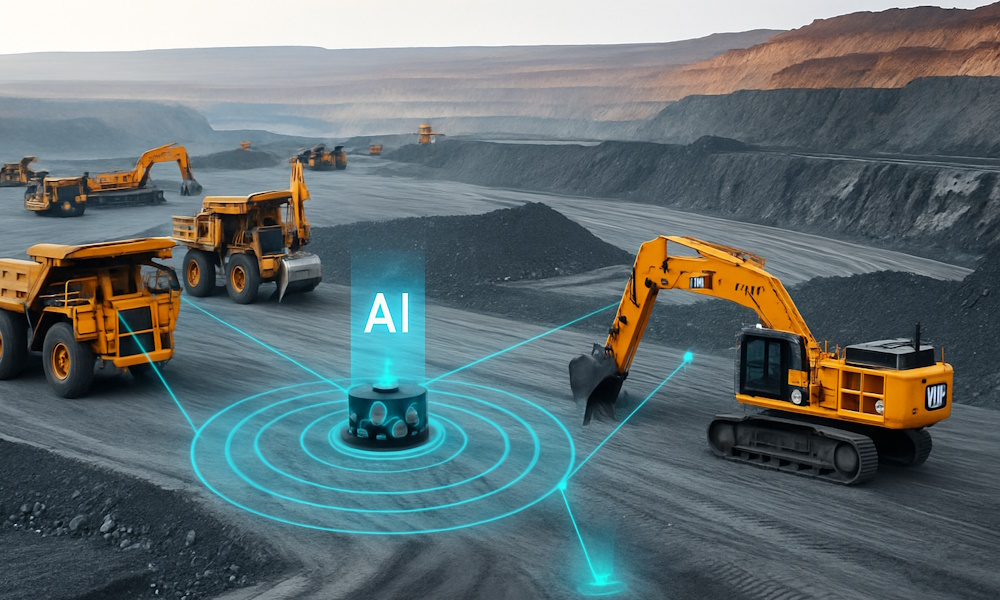
The pressure to deliver more critical minerals has never been higher. In parallel, expectations around safety, cost discipline, and environmental performance continue to intensify. These twin demands have created the conditions for artificial intelligence to become one of the most transformative forces in modern mining. What once sounded speculative is now taking shape on the ground: AI is helping teams make faster decisions, remove people from hazardous areas, and keep plants and fleets operating at peak performance.
Across exploration, extraction, processing, maintenance, and planning, the common advantage is time. Faster decision cycles, greater equipment uptime, and real-time feedback give supervisors the ability to act during the shift—rather than a week later, when reports finally arrive. As time improves, so do safety outcomes, operational stability, and cost control.
Operations That Learn While They Run
Automation is evolving alongside AI, and the integration is powerful. Consider the repetitive and often uncomfortable inspection work along crusher corridors. While essential for asset health, the task exposes workers to heat, dust, and confined spaces. Today, a sensor-rich quadruped robot can conduct these patrols autonomously. It identifies abnormal vibrations, listens for bearing and gearbox signatures, monitors temperatures, and enters restricted zones safely and consistently.
The data flows directly into reliability systems, giving maintainers early warnings and operators a clearer picture of risk. The result is fewer unexpected failures, more orderly maintenance windows, and improved asset availability.
Data Quality: The Quiet Success Factor
The greatest risk to AI is not the algorithm—it’s poor data. “Garbage in, garbage out” still applies. Machine-learning models can flag missing or improbable values, but teams must still retire faulty sensors, clean historical data, and enforce high standards for new instrumentation. It may not be glamorous work, but it is foundational.
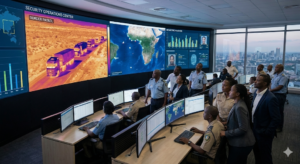
Modern mines generate millions of data points every week across plants, pits, logistics, and supporting systems. Historically, converting that signal into meaningful action took too long. Now, AI-supported trend visualisation enables teams to see issues emerging in real time—not merely review what went wrong last month.
With that visibility, metallurgists can adjust water, energy, and reagent usage during the shift. Specialists no longer need to be on-site; secure remote platforms allow them to review mill performance from anywhere and advise teams immediately. Control rooms are evolving toward clearer visibility and, over time, safe remote operation where appropriate.
Scaling Safety and Sustainability
AI earns rapid returns when it reduces exposure. Autonomous systems, drones, and fixed sensors reduce the number of people climbing structures, walking dusty corridors, or entering active operational zones. Fewer entries mean fewer opportunities for slips, trips, falls, and equipment interactions—while monitoring coverage improves.
Environmental performance follows a similar pattern. Real-time anomaly alerts help teams respond before minor deviations become reportable events. Smarter metering and predictive controls limit energy use during low-value periods, while optimised dosing reduces reagent waste. Plants run closer to target with lower variance, reducing both cost and environmental footprint.
Culture Still Determines Success
Technology alone does not deliver transformation. People must trust that new tools are designed to protect them and enhance their work—not replace their future. When leaders emphasise care rather than mere compliance, adoption accelerates. As roles evolve, exposure decreases, and workers shift toward higher-skill oversight positions. Clearly communicating these benefits is essential to long-term cultural acceptance.
Economics That Keep Mines Viable
Unplanned downtime remains one of the industry’s costliest challenges. Predictive maintenance is one of AI’s clearest wins. Using vibration, temperature, pressure, and lubrication data, models can detect failure signatures long before they are obvious to human senses. This allows planners to schedule interventions at precisely the right time—parts in place, technicians ready, and minimal disruption.
Automation also eases labour constraints. Remote monitoring and semi-autonomous equipment allow smaller teams to manage larger footprints with greater accuracy. Generative AI accelerates routine tasks such as drafting policies, preparing RFPs, or creating training outlines. Engineers can iterate mine-design models faster. Human oversight remains essential, but cycle times shrink dramatically.
Not every operation can adopt full autonomy. Brownfield sites often lack the road width or traffic separation required for driverless haulage. However, meaningful progress is possible without full redesigns. Targeted automation in drilling, dozing, or specific haul zones, combined with advanced analytics and robotic inspections, still delivers substantial gains.
What Comes Next
The direction is clear: deeper AI adoption across the value chain. Drilling rigs will increasingly manage their own control logic. Plants will self-optimise within metallurgist-defined guardrails. Maintenance strategies will become fully predictive, and real-time translation tools will support multilingual fieldwork.
Two enablers will determine who benefits most:
- Leadership and culture: Teams adapt quickly when they know people come first. Trust accelerates change.
- Data discipline: Clean tagging, clear ownership, and ongoing cleanup of legacy systems ensure models learn from signal—not noise.
Industry collaboration will further accelerate progress. Shared safety lessons, open dialogue on data architecture, and joint OEM pilot programs reduce duplication and raise the performance baseline. Professional societies play a key role in connecting operators, vendors, and researchers to share practical insights.
This shift is not about eliminating people. In the near term, AI and automation increase demand for specialised roles—data scientists, control engineers, reliability experts, and frontline leaders who can bridge operations and analytics. Over time, headcounts may stabilise or decline as autonomous design principles mature, but the work remains: planning, oversight, exception management, and stewardship of the systems that keep mines safe and productive.
A Smarter, Safer, More Sustainable Path Forward
Global demand for lithium, nickel, copper, silver, and other critical minerals continues to climb. Communities expect safer, higher-quality jobs. Investors expect disciplined spending and consistent production. AI aligns these goals. It gives teams the visibility to act early, the insight to operate efficiently, and the tools to reduce risk in the toughest environments.
Mining has always rewarded sound judgment and continuous improvement. AI is the next toolset that strengthens both.
Use it to see sooner.
Use it to decide faster.
Use it to keep people out of harm’s way.
Build a culture that welcomes change without fear.
Protect the data that powers your systems.
Share what works.
Do this, and the industry can meet rising mineral demand with safer operations, stronger economics, and a lighter environmental footprint.