As the African Continental Free Trade Area (AfCFTA) gains momentum, nations are moving beyond physical barriers, embracing digital transformation to balance robust national security with efficient trade and travel.
The New Paradigm of African Sovereignty
Africa stands at a defining juncture. The operationalization of the African Continental Free Trade Area (AfCFTA) promises unprecedented economic integration, necessitating the free movement of goods and people. Yet, this economic imperative collides with a complex security landscape. From the vast Sahelian stretches to busy coastal shipping lanes and booming metropolitan airports, the continent faces multifaceted threats: transnational crime, illicit trafficking, terrorism, and biosecurity risks.
The traditional border management model—reliant heavily on physical manpower, concrete barriers, and siloed paper-based systems—is no longer sufficient. It is too slow for trade and too porous for modern threats.
Entering 2026, the paradigm is shifting towards the “Smart Border.” This is not merely about buying newer gadgets; it is a strategic overhaul that integrates intelligence, surveillance, and data analytics to create a cohesive national defense system. A Smart Border does not just stop threats; it facilitates legitimate movement, turning border posts from bottlenecks into economic accelerators. This article explores how technology is redefining security across Africa’s three critical domains: air, land, and sea.
The Air Domain: The Biometric Corridor
African airports are the continent’s handshake with the world and the fastest conduits for commerce. They are also high-stakes environments where security must be airtight without crippling passenger throughput. By 2026, the leading African hubs are transitioning from “checkpoint security” to “flow security.”
The End of the Passport Queue? The cornerstone of the smart airport is advanced biometrics. We are moving beyond simple fingerprint scanners toward facial recognition and iris scanning capable of identifying individuals “on the move.” Integrated with Advanced Passenger Information (API) and Passenger Name Record (PNR) data before a traveler even lands, these systems allow authorities to risk-assess passengers preemptively. Low-risk travelers enjoy a seamless, near-walk-through experience, while security resources are focused intently on high-risk anomalies.
AI in the Hold Below the concourse, Artificial Intelligence is revolutionizing baggage screening. Conventional X-ray scanning relies heavily on human vigilance, which degrades over long shifts. AI-driven computed tomography (CT) scanners can automatically detect explosives, weapons, and illicit substances with higher accuracy and speed, flagging only suspicious items for human review.+1
The Land Frontier: Eyes Over the Horizon
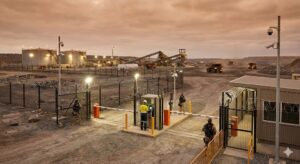
Africa’s land borders are notoriously difficult to police. They often span immense, rugged terrains characterized by informal crossings and limited infrastructure. Managing these vast spaces requires technology that acts as a force multiplier.
The Aerial Sentinel Unmanned Aerial Vehicles (UAVs), or drones, are becoming indispensable. In 2026, we are seeing deployments move beyond simple camera drones to long-endurance UAVs equipped with thermal imaging, synthetic aperture radar (SAR) to see through dust or foliage, and signals intelligence capabilities. These assets provide real-time surveillance over hundreds of kilometers of remote borderland that would require battalions to patrol physically.
Virtual Fences and Mobile Scanning On the ground, the smart border utilizes a “virtual fence” approach. Unattended Ground Sensors (UGS)—seismic, magnetic, and acoustic—can detect vehicle or foot traffic in remote areas, triggering alerts in centralized command centers.
For trade corridors, the bottleneck of manual cargo inspection is being addressed by high-energy mobile X-ray scanners. These truck-mounted units can scan entire shipping containers in minutes at land ports of entry, detecting contraband without requiring the cargo to be unloaded, drastically reducing transit times along major trade routes like the North-South Corridor.
Maritime Security: Domain Awareness in the Blue Economy
Africa’s coastline is vital to its economic future, handling over 90% of its imports and exports. Yet, these waters are plagued by illegal, unreported, and unregulated (IUU) fishing, piracy, and narcotics smuggling.
Seeing the Unseen at Sea The challenge in the maritime domain is Maritime Domain Awareness (MDA)—knowing who is in your waters and what they are doing. Smart coastal security relies on fusing data sources. Satellite imagery combines with Automatic Identification System (AIS) tracking to identify vessels.+1
Crucially, analytics platforms can now detect “dark vessels”—ships that switch off their AIS transponders to engage in illicit activity. By correlating satellite radar data with known shipping lanes, authorities can pinpoint these anomalies. Coastal radar systems integrated with long-range thermal cameras provide the final tactical layer for intercepting vessels approaching shore.
The Central Nervous System: Data Fusion and AI
The defining characteristic of the Smart Border in 2026 is integration. A drone sensing a border crossing, a facial recognition hit at an airport, and a dark vessel alert off the coast are useless if they remain siloed information.
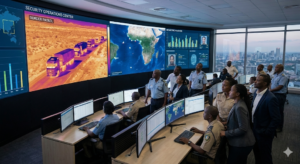
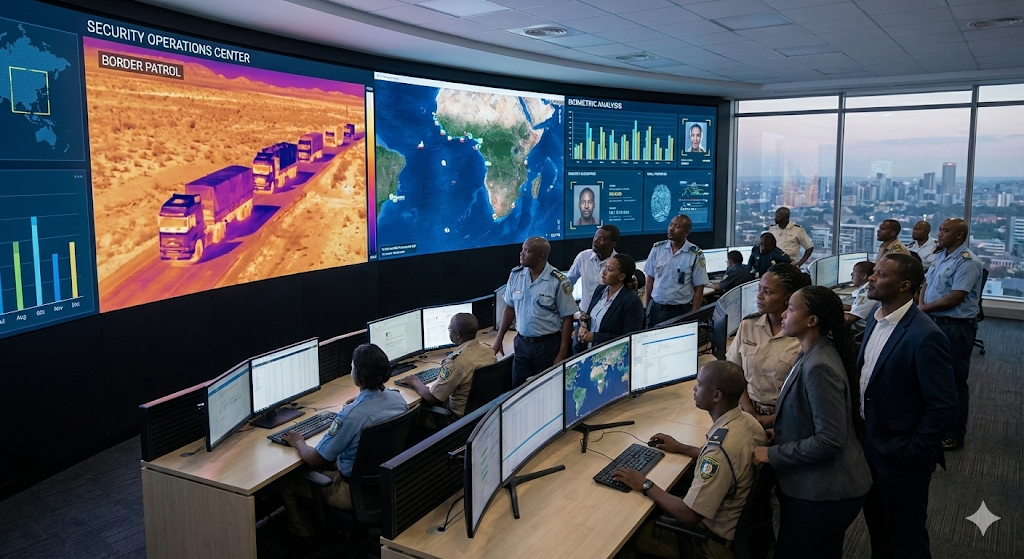
The future lies in national or regional Data Fusion Centers. These hubs ingest data streams from all domains—air, land, and sea—along with intelligence databases.
This is where Artificial Intelligence provides its greatest value: predictive analytics. Instead of just reacting to a breach, AI algorithms analyze historical data patterns to predict where smuggling routes might shift, anticipate surges in migration flows, or identify emerging modus operandi of criminal networks. This shifts border security from a reactive stance to a proactive, intelligence-led posture.
The Imperative of Interoperability
Building Smart Borders is capital-intensive, requiring significant investment in infrastructure, connectivity, and training. However, the cost of inaction—in lost customs revenue, stifled trade, and compromised national security—is far higher.
The success of this transition by 2026 will depend not just on the technology purchased, but on interoperability. Systems must be able to speak to each other across different agencies (customs, immigration, police, military) and across national borders between neighbors.
The ultimate goal of the Smart Border is a paradox that technology solves: making the border more secure while simultaneously making it invisible to legitimate enterprise.