

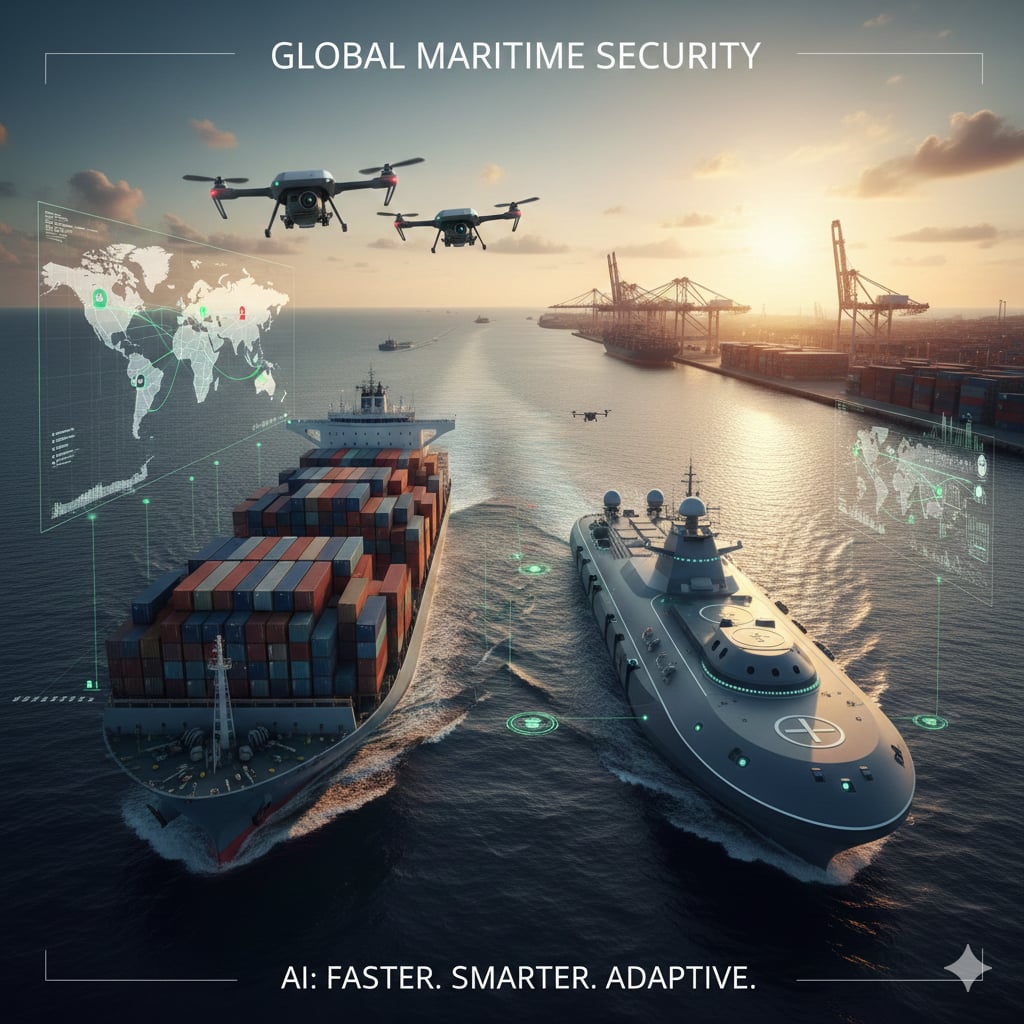
In today’s interconnected world, the seas are both arteries of global commerce and arenas of complex security challenges. From piracy and smuggling to cyber threats and critical infrastructure protection, maritime security demands systems that are faster, smarter, and more adaptive than ever before. Enter Artificial Intelligence (AI) — a transformative force reshaping how nations, navies, ports, and commercial operators safeguard the world’s oceans.
Across the globe, the maritime domain is a backbone of commerce, strategic mobility, and national security. With over 90% of global trade seaborne and complex geopolitical challenges rising in littoral zones, seafarers and authorities alike face an evolving risk landscape that demands smarter, faster, and more resilient security systems. Today, Artificial Intelligence (AI) stands at the forefront of this transformation—reshaping maritime safety and security with unprecedented precision and speed.
From Data Overload to Actionable Intelligence
Modern maritime environments generate massive streams of data: radar returns, satellite imagery, Automatic Identification System (AIS) transmissions, sensor feeds from drones and vessels, and much more. Historically, the sheer volume of this data outpaced human capability to interpret it in real time. AI is changing that.
By deploying deep learning and machine-learning algorithms, security systems can now process diverse sensor inputs and automatically detect and classify maritime targets—whether a fishing trawler drifting off course or a fast-moving unregistered vessel engaged in suspicious behavior. These models dramatically enhance situational awareness, flagging anomalies that would likely elude traditional surveillance and manual monitoring.
In naval operations and coastal surveillance, for example, AI systems are being used to enhance threat monitoring, integrate multisource data, and support real-time decision making—making the vast and dynamic maritime domain more manageable for security forces.
Autonomous Systems Expand the Reach of Security Operations
In tandem with AI’s analytic power, unmanned systems—from aerial UAVs to uncrewed surface and underwater vessels—are extending surveillance reach beyond human limits.
AI-equipped drones can autonomously patrol high-risk areas, feed live data back to command centers, and support multiple missions: detection of illegal fishing, rapid response coordination, and even search and rescue operations. Recent research shows that integrating AI with UAVs significantly improves situational awareness and response times in both security and safety scenarios.
This capability not only increases operational tempo but also reduces risk to human crews on dangerous or long-duration missions—a crucial advantage in contested or remote environments.
Predicting Threats Before They Materialize
One of the most compelling promises of AI in maritime security is predictive analytics. By learning patterns over time from historical and real-time data, AI models can forecast potential security breaches or anomalous vessel behavior before they escalate. This proactive stance marks a shift away from reactive responses to anticipatory action—an essential evolution in an age of fast-moving threats.
Predictive capabilities empower naval commanders, coast guards, and port authorities to allocate resources more effectively—directing patrols to where they’re needed most and detecting early signs of illegal activity such as smuggling or covert surveillance operations.
Fortifying Digital Defenses in a Connected Maritime World
As maritime networks become increasingly digital—with autonomous ships, connected ports, and integrated communications—the cybersecurity landscape has grown more complex. AI is now a cornerstone of maritime cybersecurity, detecting intrusions, recognizing abnormal network behavior, and enhancing risk mitigation processes.
Recent studies highlight how machine-learning–based intrusion detection systems, anomaly detectors, and AI-driven threat analytics can automate defense across maritime networks, securing vessels, port infrastructure, and communication links more effectively than legacy systems.
However, these advancements also spotlight new challenges: limited maritime-specific data for training models, regulatory constraints, and the need for explainability so operators can understand and trust AI decisions during critical incidents.
Navigating Toward a More Secure Maritime Future
The rise of AI in maritime security is not without hurdles. Questions remain about ethical deployment, interoperability, and ensuring robust cybersecurity in AI-driven systems. Moreover, as countries expand their use of autonomous maritime systems, international regulatory frameworks and norms will play a pivotal role in governing safe and responsible AI application.
Yet, what is clear is that AI’s role in maritime security is no longer theoretical—it is already reshaping how states and industries protect lives, commerce, and sovereign waters. Through smarter surveillance, autonomous operations, predictive insights, and enhanced cyber defense, AI is helping transition maritime security toward a more resilient, responsive, and intelligent era.
As the maritime domain continues to evolve, so too must the technologies we rely on to keep it safe and secure. In this dynamic environment, AI stands as one of the most transformative tools of the 21st century.