Artificial intelligence has moved from the margins of the security conversation to its centre. Across Africa, security leaders are under pressure to do more with less: protect growing urban populations, secure critical infrastructure, and respond faster to incidents—often with limited budgets, skills shortages and uneven infrastructure. Against this backdrop, AI is frequently presented as a silver bullet. The reality is more nuanced. AI can transform physical security, but only when it is deployed with a clear understanding of Africa’s operational, social and regulatory realities.
From passive systems to intelligent security
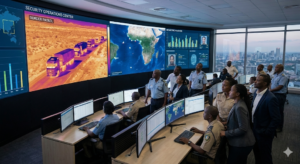
Traditional physical security systems have largely been reactive. Cameras recorded incidents after the fact, alarms triggered generic alerts, and access control systems enforced basic permissions. AI changes this dynamic. Video analytics can now detect unusual behaviour, abandoned objects, perimeter breaches or crowd build-ups in real time. Access control platforms can identify anomalies in credential use or detect tailgating before it becomes a security breach.
For African security operations—where personnel are often stretched across large sites or multiple facilities—this shift from passive monitoring to intelligent assistance is significant. AI does not replace guards or control-room operators; it augments them, enabling smaller teams to manage wider areas with greater situational awareness and faster response times.
Use cases shaped by African realities
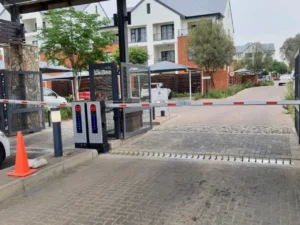
The strongest AI deployments are those rooted in local needs rather than imported concepts. In dense urban centres, AI-enabled traffic and crowd monitoring can help reduce accidents and improve public safety. In mining, energy and transport infrastructure, intelligent perimeter detection and asset tracking address persistent risks such as theft, sabotage and unauthorised access. In healthcare and education campuses, AI can flag aggressive behaviour or unauthorised movement, improving safety without requiring round-the-clock staffing.
Crucially, many African deployments prioritise systems that can operate reliably at the edge, with limited bandwidth and intermittent connectivity. AI that works offline or in hybrid environments is often more valuable than cloud-dependent solutions that assume stable power and fibre connectivity.
Infrastructure, data and the question of trust
AI adoption in physical security is inseparable from infrastructure and data governance. Power instability and network gaps mean resilience must be built into system design. Edge processing, local storage and intelligent failover are not optional—they are fundamental.
Equally important is the issue of data. Across the continent, data-protection regulations are maturing, and public awareness of surveillance and privacy is growing. Security operators must balance operational effectiveness with responsible data use. This includes clear policies on data retention, access control, audit trails and human oversight of automated decisions.
Trust is a strategic asset. Organisations that deploy AI transparently and ethically are more likely to gain acceptance from employees, communities and regulators. Those that do not risk reputational damage and regulatory backlash that can outweigh any operational gains.
What AI changes inside security organisations
Adopting AI is not just a technology upgrade; it is an organisational shift. Procurement decisions increasingly focus on total cost of ownership rather than upfront hardware spend. AI systems require ongoing model updates, cybersecurity management and operator training.
Security personnel themselves need new skills. Control-room operators must learn how to interpret AI alerts, understand confidence levels and validate automated detections. Integrators and service providers must bridge the gap between physical security expertise and data-driven system management. In Africa, where skills development is a strategic priority, this creates both a challenge and an opportunity for the industry.
Risks that cannot be ignored
AI introduces new risks alongside its benefits. Poorly trained models can generate false alarms or biased outcomes, undermining trust and operational effectiveness. Cyber threats targeting connected cameras and sensors can turn security tools into vulnerabilities. Vendor lock-in can leave organisations dependent on proprietary systems with limited flexibility.
Mitigating these risks requires disciplined governance: clear use-case definitions, human-in-the-loop decision-making, regular system audits and a strong focus on interoperability and cybersecurity from the outset.
A pragmatic path forward
For African security leaders, the most successful AI strategies are measured rather than ambitious. Start with clearly defined problems, pilot solutions in real operating conditions, and scale only once value is proven. Invest as much in people and processes as in technology. Build governance frameworks early, before systems become complex and entrenched.
AI will not eliminate the need for human judgement, local knowledge or ethical responsibility. What it can do is make physical security smarter, faster and more proactive—if deployed with realism and care.
AI adoption in Africa’s physical security sector is not about chasing global trends; it is about solving local problems more effectively. When aligned with Africa’s infrastructure realities, regulatory direction and social context, AI becomes a powerful tool to enhance safety and resilience. The organizations that succeed will be those that treat AI not as a shortcut, but as a long-term capability—built thoughtfully, governed responsibly and anchored in the real-world needs of the communities they serve.