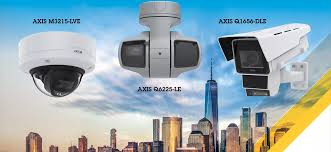
In recent years, Axis Communications — the global pioneer and leader in network video and IP-based surveillance solutions — has significantly expanded its presence and offerings across Africa. What began as a focus on Northern Africa has grown into a strategic, continent-wide engagement, with particular emphasis now on southern Africa.
A pivotal moment came when Axis established a dedicated sales office in Johannesburg, South Africa — marking a clear commitment to serve the southern African region directly rather than via distant distributors. This move allowed Axis to build on existing relationships with local distributors and system integrators, enabling faster deployment of its technologies and more responsive support tailored to African environments.
Additionally, Axis has doubled down on partnerships with regional distributors — for instance, in South Africa and across the continent — to extend its reach across multiple countries, sectors, and types of installations.
New generation of solutions designed for African needs
Axis’s recent product and service launches reflect a deep understanding of the diverse requirements faced by African businesses, institutions, and public-safety stakeholders. Among the most significant is the launch of the AXIS Camera Station Edge (ACS Edge) along with AXIS Camera Station Cloud Storage (ACS Cloud Storage).
- ACS Edge enables video data to be processed directly on the camera (“on-camera analytics”), rather than relying on external servers or traditional cloud-based video-management systems. This “cam-to-cloud” approach reduces infrastructure complexity, lowers total cost of ownership (TCO), and simplifies deployment — which is especially beneficial in regions where server hosting, stable connectivity, or centralized video-storage resources may be limited.
- ACS Cloud Storage provides a managed cloud storage option for footage, giving businesses flexibility: on-premises, cloud, or hybrid storage depending on their operational requirements, budgets, and network conditions.
By offering this flexible portfolio — edge, cloud or hybrid — Axis enables African organizations to choose what best suits their environment: from urban centres with good connectivity to remote or resource-constrained locations where minimizing infrastructure is critical.
Advanced AI-powered hardware for modern security challenges
In parallel to software innovations, Axis has rolled out cutting-edge camera technologies to tackle some of the most stubborn security challenges in Africa. In 2025, a local distributor — Duxbury Networking — began offering Axis’s latest AI-powered pan-tilt-zoom (PTZ) cameras to South African security integrators and customers.
These new Axis PTZ cameras offer features that directly address conditions common in African environments:
- High-quality imaging: Some models deliver 4K UHD resolution, while using highly light-sensitive sensors to produce clear images — even under challenging lighting or shadow conditions.
- Low-light and night capability: With technologies like OptimizedIR, these cameras can operate in total darkness for up to 300 m without the need for extra lighting — crucial for perimeter security, rural deployments, or poorly lit areas.
- AI-powered analytics built-in: Rather than relying on manual monitoring, these cameras use onboard AI to automatically classify objects (people, vehicles, trucks, etc.) in real time. This significantly reduces false alarms by ignoring irrelevant triggers (e.g. animals, shadows, weather), allowing security personnel to focus on genuine security events.
- Scalable and integrable: Thanks to the open-platform approach that Axis advocates, these cameras can be integrated into broader security architectures — including multi-sensor sites, complex perimeters, and hybrid solutions combining video surveillance with other systems.
For organisations operating across large campuses, warehouses, industrial facilities, transport yards or sprawling public-space environments — common in many African urban and semi-urban landscapes — this combination of AI-driven detection, high-performance imaging and scalable integration is a game-changer.
Real-world impact: examples from Africa
The roll-out of Axis systems across Africa is not a theoretical exercise: several institutions and major sites have already benefited.
In South Africa, for instance, University of the Western Cape (UWC) replaced an outdated analogue surveillance setup with a modern, networked video system powered by Axis cameras. The upgrade enabled the university to protect staff, students, buildings and resources more effectively — even across multiple buildings and campus entry points. The adoption of Axis’s compression and bandwidth-saving algorithms (e.g. Zipstream) allowed UWC to manage large numbers of cameras (over 2,000 devices) while keeping storage and network demands manageable.
Another example is the transformation of one of Africa’s most prestigiously visited mixed-use developments, V&A Waterfront in Cape Town. The complex replaced old analogue systems with an integrated Axis-powered digital surveillance solution that supports large visitor volumes, retail operations, vehicular traffic, and evolving infrastructure. By leveraging analytics, vehicle flow monitoring, people-counting, license-plate recognition and integrated video management, V&A now maintains high safety standards, monitors crowd and traffic flow, and supports efficient operational control — all while being ready for future expansion.
These examples demonstrate how Axis’s technology isn’t just deployed in high-security or industrial contexts — it also serves everyday institutions, urban public spaces, and commercial developments, helping deliver safety, operational efficiency, and peace of mind.
Partnerships and ecosystem – building a local backbone
A critical factor in Axis’s success in Africa has been its investment in partnerships with local distributors, system integrators, and value-added resellers (VARs).
One such partnership is with Compass Visual Security, which in 2020 was appointed as a value-added distributor (VAD) for Axis in South Africa and across Africa. Compass — with decades of experience in the security industry — supplies CCTV, access control and fire detection products, and brings local presence and infrastructure including multiple branches across Gauteng, Durban and Cape Town.
More recently, the collaboration with Duxbury Networking to bring the new AI-powered PTZ cameras to South African and regional partners underscores Axis’s commitment to localized distribution, technical support, and custom integration.
Such partner networks are vital: they ensure that Axis’s global technologies are adapted, installed, and maintained in ways that reflect local realities — from urban shopping precincts and campuses to remote facilities and large industrial sites.
A forward-looking focus: sustainability and long-term value
While Axis’s primary mission lies in security and surveillance, the company has recently articulated a broader vision combining technology leadership with environmental and social responsibility. As it celebrated its 40th anniversary, Axis reaffirmed a commitment to sustainability — reducing the environmental footprint of its operations, improving energy efficiency in its products, increasing use of renewable carbon-based plastics, and embedding anti-corruption and human-rights awareness across its global operations.
For African customers, this long-term focus matters. Surveillance systems are often deployed for decades — by investing in hardware and software that is designed to be energy-efficient, scalable, and upgradeable, Axis enables organisations to build security infrastructures that remain relevant, manageable, and sustainable over many years, rather than requiring frequent overhauls.
What this means for Africa — and the future of security
The recent enhancements by Axis have significant implications for the future of security, infrastructure management, and public safety across Africa.
- Accessibility and affordability: By offering solutions like ACS Edge (which reduces dependency on servers and lowers infrastructure costs), Axis makes advanced surveillance more accessible to organisations — including those with limited budgets or operating in remote areas.
- Scalability and flexibility: Whether it’s a university, a retail complex, an industrial yard, or a public precinct, Axis’s wide range of scalable solutions enables deployments of different sizes and complexity. The open-platform approach ensures integration with other systems and adaptability to changing needs.
- Intelligence and automation: With AI-powered cameras and analytics, surveillance shifts from passive recording to proactive detection and response — reducing false alarms, lowering human monitoring burden, and enabling quicker reaction to real security events.
- Long-term viability and sustainability: Through durable hardware, efficient software, and environmentally conscious practices, Axis sets the stage for long-lasting deployments that remain economically viable and socially responsible.
- Local relevance via partnerships: By working through local distributors and system integrators, Axis ensures that solutions are contextualized to African settings — factoring in local infrastructure, regulatory landscapes, geographical constraints, and real user needs.
Axis Communications’ recent moves — from launching next-generation edge and cloud surveillance solutions to deepening its footprint via local offices and distribution partners — reflect a clear, ambitious strategy to redefine surveillance for Africa. By combining cutting-edge AI, flexible deployment options, and sustainable, scalable design, Axis is not only helping institutions and businesses respond to today’s security challenges — but also enabling them to build robust, future-ready surveillance infrastructure.
Whether for campuses, retail precincts, transport and logistics hubs, or multi-site enterprises, Axis’s expanded African surveillance offering promises greater safety, operational efficiency, and peace of mind. As the continent continues to urbanize and digitize, such intelligent surveillance systems will likely become an increasingly critical component of security architecture — making Axis a key player in shaping a smarter, safer African future.