

South Africa’s mining sector — long defined by deep-level complexity and high operational risk — is undergoing a fundamental transformation. As digitalisation accelerates across the industry, safety and security systems are evolving rapidly, driven by next-generation technologies, intelligent data analytics and a renewed commitment to zero harm.
From advanced sensor networks and real-time monitoring to artificial intelligence and autonomous systems, South African mines are increasingly deploying integrated safety and security solutions that not only meet regulatory requirements but often exceed global benchmarks. In doing so, the region is positioning itself as a leader in modern mining safety and security innovation.
A National Priority: From Legacy Challenges to Smart Solutions
Mining remains a cornerstone of the South African economy, supporting employment, export revenue and industrial development. However, the industry’s historical exposure to underground hazards — including vehicle interactions, gas accumulation, dust inhalation and ground instability — has necessitated a sustained shift toward smarter, more proactive safety systems.
Recent regulatory developments, particularly those governing collision avoidance and proximity detection on trackless mobile machinery, have accelerated the adoption of advanced safety technologies across surface and underground operations. Today, the industry’s vision extends beyond compliance. The focus is firmly on proactive risk prevention, real-time intervention and near-zero harm.
Tech-Led Transformations: What’s Changing in Mine Safety?
Intelligent Collision Avoidance & Proximity Detection
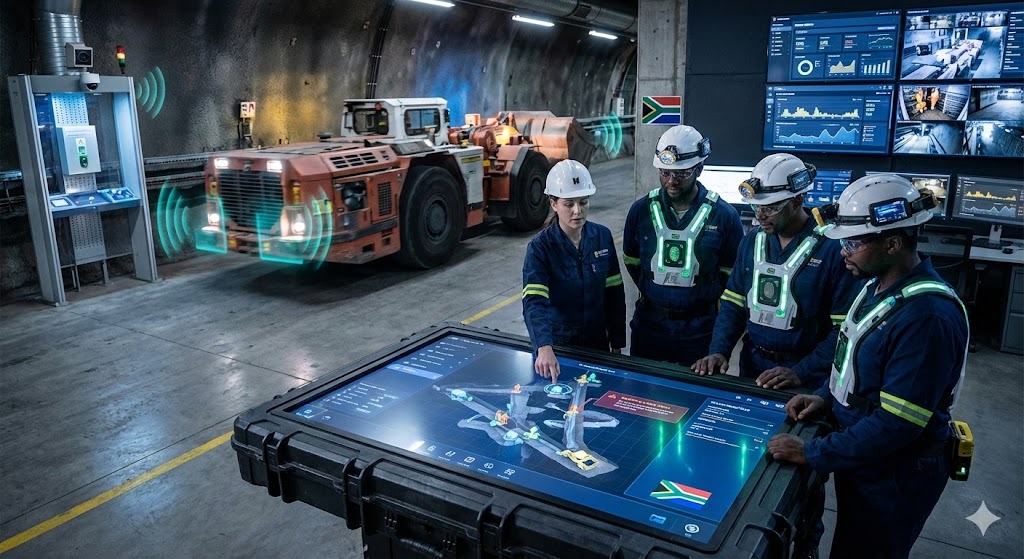
Among the most significant advancements in mine safety is the widespread deployment of Proximity Detection Systems (PDS) and Collision Avoidance Systems (CAS). These technologies create a digital safety zone around personnel and mobile equipment, using RFID, ultra-wideband (UWB), GPS and sensor fusion to detect potential collision scenarios.
Modern systems are fully integrated with vehicle control platforms, enabling automated responses such as slowing down or stopping machinery when a collision risk is detected. This marks a major evolution from earlier warning-only systems, significantly reducing human error and reaction-time dependency.
Real-Time Monitoring & Environmental Intelligence
Contemporary mine safety strategies are increasingly built on continuous environmental and geotechnical monitoring. Advanced sensor networks provide real-time visibility into critical parameters, including:
- Gas concentrations (methane, carbon monoxide and hydrogen sulfide)
- Dust and airborne particulate levels
- Ventilation performance and airflow
- Seismic activity and ground movement
These systems function as a mine’s digital nervous system, detecting abnormal conditions long before they become life-threatening and enabling rapid, informed decision-making.
South African research institutions such as the Council for Scientific and Industrial Research (CSIR) are also contributing cutting-edge innovations, including early-warning technologies that analyse micro-seismic data to identify potential rock mass instability in advance.
Wearables & Smart PPE: Personal Safety Reimagined
Personal protective equipment has evolved beyond passive protection into connected, data-driven safety solutions. Smart PPE now includes:
- Helmets with integrated environmental sensors and biometric monitoring
- Biometric vests tracking heart rate, fatigue and heat stress
- GPS-enabled tags and badges for precise personnel location tracking
These wearable technologies allow supervisors to monitor worker wellbeing, exposure levels and movement in real time, improving emergency response, evacuation planning and overall workforce safety.
AI, Machine Learning & Predictive Analytics
Artificial intelligence has become a cornerstone of modern mine safety systems. Machine learning algorithms analyse vast volumes of operational and environmental data to predict risks before incidents occur — shifting safety management from a reactive to a predictive model.
Key applications include:
- Predictive maintenance based on equipment performance trends
- Early detection of anomalies in vibration, air quality or seismic data
- AI-driven training tools and VR simulations for hazard recognition and emergency preparedness
This data-led approach significantly enhances risk mitigation while improving productivity and operational efficiency.
Enhanced Connectivity & Digital Platforms
Robust communication infrastructure underpins all advanced safety and security systems. IoT networks, underground mesh communications and real-time data platforms connect equipment, sensors, wearables and control rooms across vast mining operations.
The emergence of private 5G networks is further strengthening connectivity, enabling ultra-low-latency data transmission deep underground and ensuring that critical safety information reaches decision-makers instantly.
Security Systems: Beyond Safety to Site Protection
Mine safety systems increasingly integrate with advanced security solutions to protect personnel, assets and infrastructure. AI-powered surveillance, automated drones and intelligent access-control systems monitor perimeters, high-risk zones and critical facilities.
These technologies play a vital role in preventing theft, sabotage and unauthorised access — challenges that remain prevalent across large mining operations — while supporting safer, more secure working environments.
Human Capital: Training, Culture & Technology Adoption
While technology is a powerful enabler, it is not a standalone solution. South African mining leaders consistently highlight the importance of training, safety culture and workforce engagement.
Leading operations are investing in immersive VR training, continuous upskilling for digital system operators and participatory safety programmes that encourage trust, accountability and shared ownership of safety outcomes. These initiatives help embed safety as a core organisational value rather than a regulatory obligation.
The Future of Mine Safety & Security in South Africa
As Fourth Industrial Revolution (4IR) technologies continue to converge — including AI, IoT, robotics and advanced analytics — the future mine will be increasingly predictive, connected and autonomous. Early adopters are already reporting measurable reductions in incidents where integrated safety and security systems are fully deployed.
By embracing digital transformation, implementing holistic safety-security ecosystems and fostering a safety-first culture, South African mines are redefining what it means to protect people and assets, both underground and on the surface.
Conclusion
Safety and security in South African mining are no longer static objectives; they are dynamic, technology-driven processes powered by real-time data, intelligent systems and human expertise. From smart PPE and AI-based risk prediction to autonomous collision avoidance and environmental monitoring, the industry is pioneering solutions that are attracting global attention.
In a sector where every life matters and every incident avoided is a victory, these advancements demonstrate that innovation — when aligned with a strong safety ethos — can make mining safer, smarter and more sustainable than ever before.