
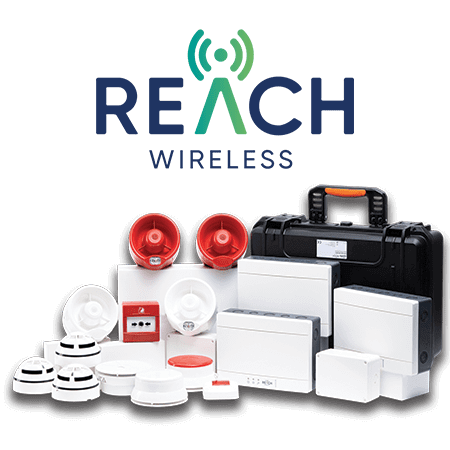
Introducing the REACH Wireless Fire System
REACH Wireless is a hybrid fire-alarm system developed by Apollo Fire Detectors. It blends traditional wired alarm-loop infrastructure with modern wireless devices — letting you combine wired and wireless detectors on the same system.
Rather than rewiring or installing new loops, REACH uses a “loop-interface” — a module that plugs into your wired fire-alarm loop and acts as a bridge. Wireless smoke detectors, heat detectors, multi-sensor units, manual call points, sounders and visual alarm devices then communicate via radio to this interface, which feeds their status back into the main fire panel.
This hybrid approach lets you extend fire detection coverage — for example to annexes, outbuildings, heritage buildings, temporary structures or remote wings — without laying new cables or building separate alarm loops.
Key Strengths
-
Flexible installation with minimal disruption: Because many devices are wireless and battery-powered, you can fit detectors without trunking, conduit, or wall/floor chasing — ideal where building structure should remain untouched (heritage sites, existing occupied buildings, complex layouts).
-
Extending existing systems easily: If a building already has a wired fire-alarm loop, REACH allows seamless expansion (for extra rooms, annexes, new wings, or outbuildings) without requiring a second fire panel.
-
Comprehensive device suite: The system supports a full range of detection and alarm devices — optical smoke detectors, heat detectors, multi-sensor (smoke + heat), manual call-points, sounders/visual alarm devices (VADs), etc. This makes it suitable for practically any fire-safety requirement.
-
Reliable wireless communication with redundancy: REACH is designed with up to 44 radio-frequency (RF) channels organized in redundancy pairs, and uses antennas positioned for strong radio signal coverage — helping ensure stable wireless links even in complex building layouts.
-
Good maintenance/performance parameters: Detectors are battery-powered and typically provide long battery life (some detectors claiming up to 10 years). Devices are individually addressable and monitored, so battery levels and faults are reported to the fire panel — increasing system integrity.
Ideal Use Cases
REACH Wireless works particularly well in situations where a conventional wired system would be difficult, expensive or disruptive to install:
-
Older buildings or heritage/ listed properties — where you want to avoid damaging walls, ceilings or architectural features with new wiring.
-
Buildings with annexes or outbuildings (e.g. main house + garage or workshop, or main building + separate storage wing) — allowing both to share the same fire-alarm system without new wiring.
-
Temporary or modular structures — such as portable classrooms, temporary offices, pop-up retail units, or renovation zones — where a full wiring installation is not practical.
-
High-rise residential buildings or complexes needing coverage across multiple units/floors — especially if retrofitting is needed and wiring would be complicated or disruptive.
-
Sites requiring fast, low-impact upgrades or extensions — e.g. schools, hospitals, office buildings — where downtime must be minimized.
What to Be Mindful About
-
Battery maintenance: Because many devices are battery-powered (rather than mains-wired), they require periodic battery replacement. Even though low-battery conditions are signalled, neglecting maintenance can compromise safety.
-
Wireless coverage limitations: Radio communication depends on building layout, materials (walls, floors), interference, and line-of-sight. Proper site surveying — often using a survey kit recommended by Apollo — is important to ensure adequate signal coverage before installation.
-
System capacity and design constraints: Each loop-interface supports a finite number of wireless devices (e.g. up to 32 per interface) and the main fire panel must have capacity; overloading a loop may exceed design limits.
-
Need for correct installation and compliance: Devices must be installed as per manufacturer guidance and in line with fire-safety standards (e.g. applicable local or international codes). Wireless systems may have extra requirements compared to purely wired systems.
REACH Wireless offers a smart, flexible, and effective approach to fire detection and alarm — combining the robustness and reliability of wired fire-alarm systems with the convenience and adaptability of wireless devices. For buildings where wiring is impractical or undesirable, or for projects requiring quick turnaround and minimal disruption, it represents a compelling fire-safety solution.
At the same time, like any system, it requires thoughtful planning, correct installation and ongoing maintenance to deliver long-term protection.